

No One Will Digitalize Your Business Processes for You
The government can introduce eInvoices. A company can purchase the latest software. A team can start using AI. Yet business processes can remain just as slow, difficult to track, and dependent on emails, spreadsheets, and human memory.
We have been developing and implementing the OWIS system for more than 20 years. Today, it is actively used by over 100 organizations, and through sales conversations, process analyses, and implementations, we have gained insight into how, without overstating it, more than 1,000 companies and institutions operate.
These organizations differ in size, industry, number of employees, and level of technological maturity. Yet the challenges we encounter have remained remarkably similar, from our first day in business until today.
Documents are often already electronic. Companies use ERP systems, accounting software, shared folders, invoice management tools, and numerous Excel spreadsheets. Despite this, employees do not always know who should take the next step, management lacks a complete overview of outstanding tasks, and important cases still depend on emails, phone calls, and someone remembering what needs to be done.
That is why one of the most important lessons we have learned is simple:
A digital document is not the same as a digitalized process.

Process Digitalization Does Not Start with Software
Business digitalization is often equated with introducing a new tool.
A company buys software, moves documents into electronic form, gives employees user accounts, and declares the project complete.
But software can only automate what the organization has already understood and defined. If it is unclear how a process begins, who takes part in it, who makes decisions, where bottlenecks occur, and what happens when something does not go according to plan, a new tool will not automatically solve the problem.
It may simply move the problem onto a screen.
The same applies to the latest technologies. As we have already written, AI agents will not fix bad processes. They will only make them faster.
eInvoices in Serbia: What Has SEF Solved?
In recent years, Serbia has taken a significant step forward in the digitalization of invoicing.
Through the Law on Electronic Invoicing and the introduction of the Electronic Invoice System, commonly known as SEF, the issuance, sending, receipt, processing, and storage of electronic invoices have been standardized, along with a significant part of electronic VAT recording.
Mandatory issuance and storage of electronic invoices in transactions between private-sector entities have applied since January 1, 2023.
This is an important infrastructure shift.
An invoice no longer has to travel in an envelope, end up on the wrong desk, or wait for someone to enter it manually into a system. Its issuance and receipt now follow a defined electronic channel, status, and legal framework.
But SEF cannot know how every individual company is organized.
It cannot know who ordered the goods or services. It does not know whether the agreed quantity was delivered, whether the price matches the contract, whether a goods receipt note exists, or who should confirm that the work has actually been completed.
The government has digitalized an important part of the exchange. But it has not, and cannot, digitalize the internal decisions, responsibilities, and ways of working within every organization.
That is where company digitalization truly begins.
What Does SEF Not Solve?
An invoice is only one point within a broader business process.
Before it appears in SEF, a purchase request may already have been created within the company. Someone had to approve it, after which a purchase order was issued, a supplier was selected, a contract was signed, and the delivery was completed.
Once the invoice is received, the company still needs to:
verify that it is correct
match it with the contract, purchase order, or goods receipt note
confirm that the goods or services were delivered
obtain internal approval
record and allocate the cost
post it in the accounting system
prepare the payment
In a simple case, several people may complete all of this within a few minutes.
In an organization with hundreds of employees, multiple locations, different levels of authority, and a high volume of documents, the same process can easily become a chain of emails, phone calls, spreadsheets, and manual reminders.
Accounting can see the invoice but may not know whether the agreed price is correct. The colleague who negotiated the purchase knows the answer but does not know that someone is waiting for it. A director needs to give approval, but the request has been lost among other messages. The payment deadline is approaching, yet no one has a complete overview of where the process has stalled.
SEF has fulfilled its purpose. The invoice has arrived electronically.
The internal process, however, has still not been digitalized.
We explored the reasons behind this in more detail in our blog post, Why Do Invoices Still Get Delayed Even When They Are Digital?
Process Digitalization in Serbia
In our conversations with companies in Serbia, we encountered almost every possible scenario.
Some use large enterprise platforms. Others have adopted the solution used across an international group. Some rely on specialized DMS tools or modules connected to an ERP system. Others have developed their own system, while in some organizations a significant part of the work is still managed through emails and spreadsheets.
In the sample we analyzed, companies that had already digitalized part of their operations were using a wide range of different solutions. No single tool clearly emerged as the market standard.
The market is therefore not simply divided into companies that have software and those that do not.
A much more important distinction exists between organizations that genuinely manage processes through software and those that use several disconnected tools between which employees still transfer information manually.
The main competitor to a new solution is often not another software provider.
The main competitor is the sentence: “We already have something.”
That “something” may perform its core function perfectly well. An ERP system can manage financial records. SEF can handle electronic invoices. A shared folder can store documents.
The problem begins when none of these systems follows the entire workflow across the organization.
Employees then connect the systems manually. They download a document from one tool, send it by email, update its status in a spreadsheet, remind a colleague by phone, and eventually enter the same data again into another system.
Technically, the company uses software.
Operationally, people are still carrying the process.
Process Digitalization in Bosnia and Herzegovina
In Bosnia and Herzegovina, digitalization has not always been driven by a single central regulatory system such as SEF.
Organizations have approached it for different reasons.
Some wanted to improve the receipt and distribution of general correspondence. Others were struggling with incoming invoice processing, contract management, or internal approvals. Some had grown so quickly that their previous way of working could no longer keep pace with the number of employees, locations, documents, and decisions.
Regardless of the initial reason, the pattern is usually the same.
An organization first assumes it has a document problem. Through analysis, it then becomes clear that the document itself is not the main issue.
The real issue is everything that happens around it.
Who receives it? Who checks the information? Who should it be forwarded to? Who has the authority to approve a certain amount? What happens when the responsible person is absent? How long does each step take? Who can see that a deadline has been missed?
In some organizations, the process begins with a physical document that is scanned at the registry office. In others, the document arrives electronically and automatically initiates a case. In some cases, completed data is sent to the ERP system for posting, while the status is then returned to the process management system.
One example is Bingo Group, where OWIS connected the registry process, the monthly processing of between 5,000 and 6,000 incoming invoices, and the ERP system.
At KappaStar Group, the processes of five affiliated companies were consolidated through centralized invoice processing and integration with the existing ERP system.
Digitalization therefore does not mean that every organization must work in the same way.
It means that its actual way of working must become visible, structured, and measurable.
Where Are Business Processes Hiding?
When people hear the term business process, many imagine complex diagrams, hundred-page procedures, and consultants spending months moving boxes around in presentations.
Most processes are far more ordinary.
A process exists when an employee sends a contract to the legal department for review.
A process exists when a director needs to approve an expense.
A process exists when HR collects documentation from a new employee.
A process exists when a purchase request is forwarded between departments.
A process exists when a purchase order, goods receipt note, and invoice need to be cross-checked.
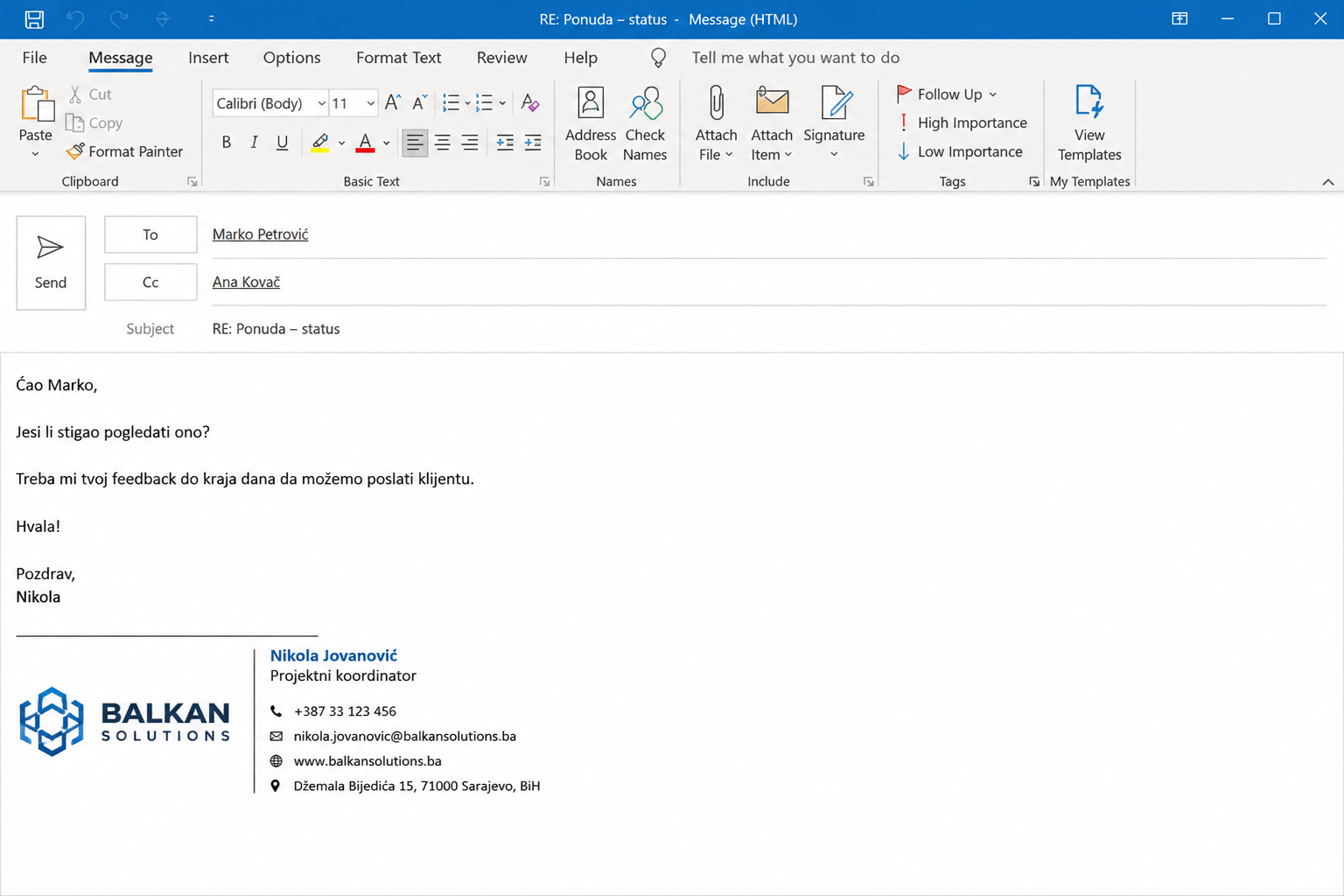
A process exists when someone emails a colleague to ask, “Have you had a chance to look at that?”
If a certain activity is repeated, passes through several people, depends on a decision, or has a deadline, you very likely have a process.
Even if you do not call it that yet.
The only difference is whether that process is clearly defined or exists as a set of unwritten rules that employees learn through experience.
Why Does Software Not Fix a Bad Process?
Companies often start in the wrong order.
They identify a problem, review several presentations, choose the tool with the longest list of features, and only during implementation try to determine what the software is actually supposed to support.
This usually creates one of two problems.
In the first case, the organization tries to force its way of working into rigid software. Users are given steps that make little sense, asked to enter information they do not need, and left searching for workarounds just to complete their tasks.
In the second case, the existing process is copied into digital form without being questioned or improved.
If a document previously sat on someone’s desk for three days, it now sits in an electronic inbox for three days. If responsibility was unclear before, it will not suddenly become clear just because the request is now displayed on a screen.
You end up with the same problem, just without the folder.
Before choosing software, it is necessary to understand how the process actually works, not only how it is described in a procedure.
Where does it begin? Who takes part in it? Who makes decisions? Where do delays occur most often? What information is missing? What happens when someone rejects a request? Who needs visibility across the entire process?
Only then can software become a solution.
Otherwise, it becomes just another system that employees have to work around.
A similar problem appears when a company tries to solve organizational complexity through a combination of general-purpose tools. Excel, SharePoint, and email can all be useful, but on their own they do not provide control over a business process.
Do You Need Separate Software for Every Process?
Another common mistake is allowing each department to solve its own problem independently.
Finance purchases an invoice management tool. The legal department introduces a contract management system. Administration uses another solution for correspondence. HR has its own application, while internal approvals and requests continue to be managed through emails and spreadsheets.
Each tool may be effective on its own.
But the organization as a whole ends up with more user accounts, more databases, more places to search, and even less of a unified overview.
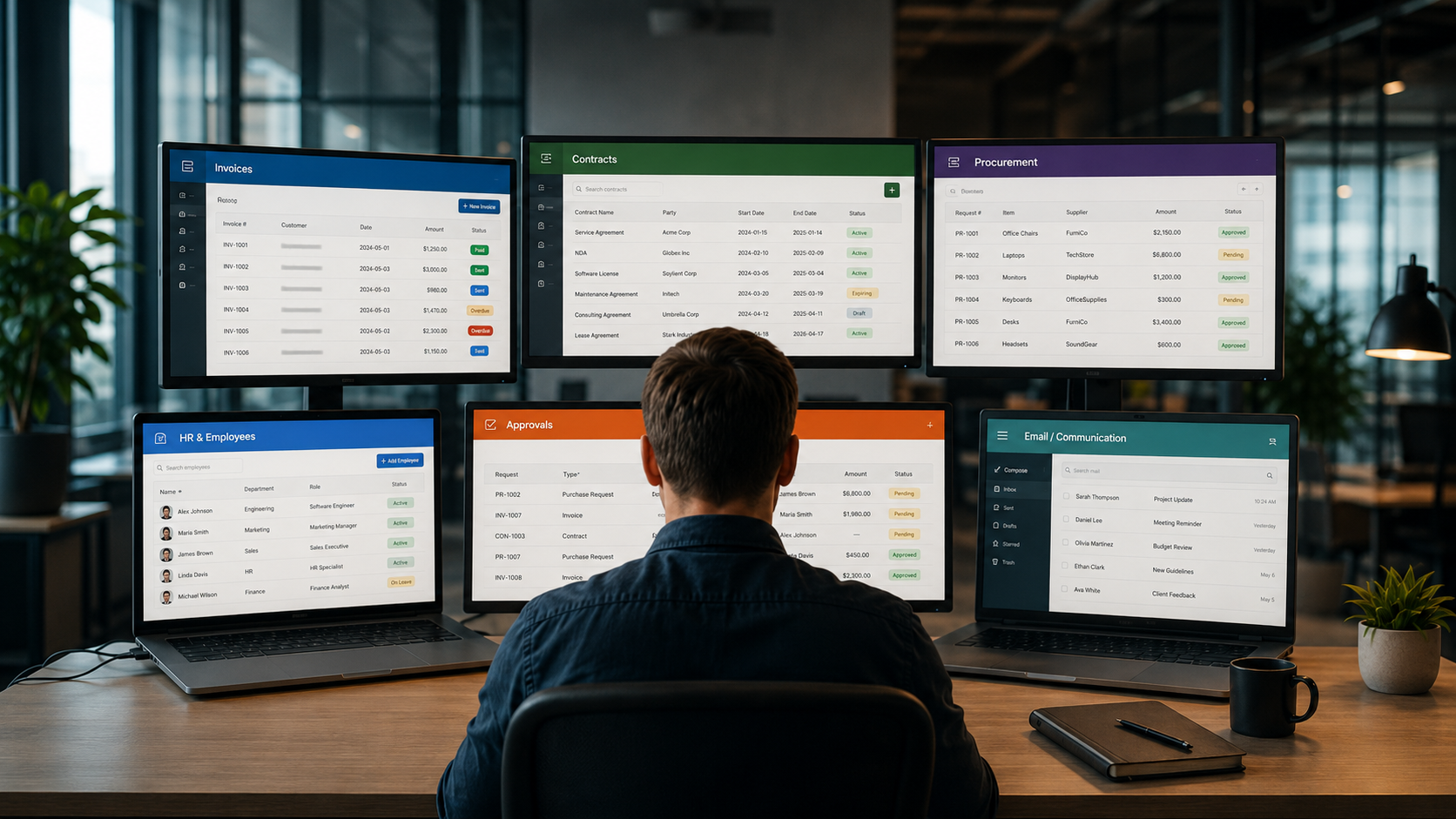
One Software Solution for Every Process May Not Be the Best Approach…
That is why OWIS was not developed merely as an electronic archive or as a tool for a single predefined process.
OWIS is a platform through which an organization can model, manage, and monitor different workflows, including:
incoming invoices
contracts
general correspondence
procurement
purchase orders
internal requests and approvals
HR procedures
business-specific processes unique to the organization
This does not mean that one platform should replace every specialized business system.
An ERP system should continue doing what it was designed to do. SEF should remain the central platform for the legally defined exchange of electronic invoices. Other specialized tools can continue performing their respective functions.
The point is that an organization does not need to purchase a new, isolated application every time it identifies a process it wants to improve.
A process management platform can connect people, documents, decisions, and existing systems into one coherent workflow. We explored this topic in more detail in our article on OWIS and no-code ERP integration.
How Can You Gain a Clear Overview of Your Business?
For an employee, digitalization means finding a document more easily, knowing what their next task is, and no longer having to remind colleagues manually.
For management, it must mean much more.
How many cases are currently open?
At which step do bottlenecks occur most often?
How long does invoice or contract approval take on average?
Which deadlines are being missed?
Does a particular department or employee regularly become a bottleneck?
How many cases are returned for additional information?
What has been completed, what is still pending, and why?
When a process is managed through emails, phone calls, and separate spreadsheets, answering these questions requires information to be collected manually.
When the process is managed through a system, every step leaves a trace.
A document has a status. A task has a responsible person. An activity has a completion time. A decision has a history. Management no longer needs to ask ten people what is happening because it can see the current state of the process.
This is the broader value of digitalization.
It is not only about completing individual tasks faster. It is also about understanding more clearly how the organization operates.
Information does not need to remain buried in long lists and reports. OWIS workspaces and widgets allow different users to see the processes, tasks, and indicators that matter to them in one place.
How Should You Start Digitalizing Business Processes?
Before reviewing the feature list of any solution, an organization should answer several basic questions:
What triggers the process?
Who takes part in it?
Who makes decisions, and based on which information?
Which documents are created or used?
Where does the process most often come to a halt?
Which deadlines and levels of responsibility apply?
What happens when someone rejects a request or required documentation is missing?
Which information does management need to monitor?
Which existing systems need to exchange data with the process?
Could the same platform also support other similar processes within the organization?
The answers do not need to be perfect from the beginning.
But without them, it is difficult to distinguish software that will improve the business from software that will simply hide the existing chaos in digital form.
To help companies navigate the entire journey, from analyzing their current state and selecting a solution to implementation and continuous optimization, we prepared a free Guide to Digitalizing Process and Document Management in the Private Sector.
Through nine practical steps, the guide helps organizations assess their needs, goals, resources, and team readiness before purchasing software, while avoiding costly mistakes during implementation.
Digitalization Starts with Analysis
The government can build digital infrastructure and regulate the electronic exchange of documents.
Software providers can develop tools for automation, integration, and task management.
Consultants can help an organization analyze and improve the way it works.
But no external party can clearly define a company’s responsibilities, deadlines, rules, and decision-making processes on its behalf.
That is why business process digitalization does not begin with purchasing a license.
It begins with an honest look at how work is actually carried out.
The greatest challenge is not converting paper into a PDF or connecting two information systems. The greatest challenge is making the work of the organization visible, clear, and measurable.
Only then does software stop being just another tool.
It becomes a way to truly manage the business.